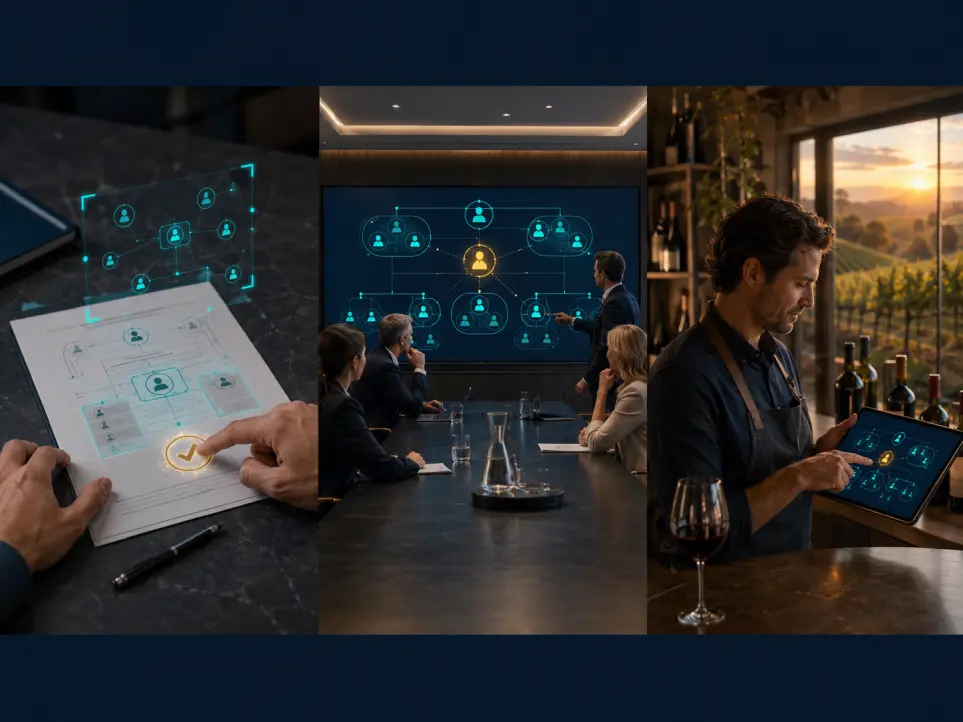
A structured working session for enterprise leaders: which job families are changing first, where human judgment must stay explicit, which workforce moves to sequence — and which to stop funding now.
Tools don't transform. People do. This session runs on the MyAIRole Work Structure Framework — the only role-level diagnostic built from the task up, not the org chart down. Applied at enterprise scale, it draws on 25+ years of designing the operating structures organizations need before deploying technology, including mapping exactly where sequencing breaks down when that redesign is skipped. Leadership teams leave with a defined operating model: every job family mapped, every accountability gap named, a sequenced 90-day action plan in hand. The enterprise is Rewired for Relevance before they walk out.
Start with the session that maps your workforce — or the whitepaper that shows you where the gap is.
The window is narrowing. AI is already restructuring job families in your sector. Organizations that map this now set the terms. The ones that wait govern the results of decisions they never made.
Tools don't transform. People do. Organizations 18–36 months into AI adoption — past the pilot stage, short of scaled value — are learning this the hard way: tool access is not the constraint.
They lack a structured way to determine where work is changing first, which job families need different capability strategies, and where human judgment must stay explicit — specifically, which decisions AI cannot own and which it must not.
That is where workforce transformation becomes an operating-model issue — and where moving first compounds into competitive advantage.
The work requires a role-level diagnostic: built from the task up, mapping which specific tasks AI is changing before any capability or talent decision is made. The MyAIRole Work Structure Framework is the only one built to deliver it. Generic AI advisory skips this step entirely.
Here is how the framework maps to your specific job families — and how it moves leadership teams through Clarity → Plan → Results in a single session.
One page. Five minutes. Everything your leadership team needs to decide if this session is right.
Most AI workshops stop before the question that drives operating performance: which job families are changing, in what sequence, and where human judgment must stay explicit. Remove it, and the accountability structures that make AI expansion defensible collapse. They focus on tools, use cases, and adoption messaging. This session focuses on the operating model. This session answers those questions with a named, role-level framework. Other workshops do not.
The session surfaces which job families are already restructuring and which capability gaps will emerge in the next two quarters — so leadership teams leave with a prioritized map, not more open questions.
Request Workshop Overview →The MyAIRole Work Structure Framework maps every job family against two dimensions: which tasks AI can Accelerate · Automate · Redefine · Elevate (the Task-Change Map) — and which decisions require irreplaceable human accountability — the judgment AI cannot replicate and organizations cannot afford to cede. The output is a clear role map: which positions are execution-accelerated and which carry judgment accountability. See what leadership teams leave with →
This session produces a sequenced workforce action plan: which roles to redesign in the next quarter, which capabilities to build or source, and which AI implementations are already outpacing the decision structure behind them — so the enterprise stays Rewired for Relevance instead of reactive.
Here is what your leadership team leaves with — and how the session moves them through Clarity → Plan → Results before they walk out the door.
This workshop gives enterprise leadership teams a role-level map of which job families are changing first — and a sequenced plan for what that requires of capability, talent, and operating model design — before the next quarter of AI investment is committed.
Every session follows the same diagnostic structure — Clarity → Plan → Results — applied to your specific job families, your data, and your leadership team's decisions. The rigor is consistent. The map it produces is yours. The session produces a prioritized view of which job families to act on first, which capabilities to build or source, and how the enterprise structures its workforce to genuinely Partner With AI — a different operating requirement than adoption alone. Want to see how it applies to your specific job families?
This session ends with decisions made, commitments named, and a workforce roadmap in hand. Leadership teams leave with answers, not a report to review later.
Designed for the executive accountable for turning AI investment into workforce performance — and the cross-functional leadership team responsible for executing it.
Every session closes with five decision-ready outputs built from role-level task mapping — not executive interviews, benchmarking surveys, or generic maturity models. Together they move leadership through Clarity → Plan → Results — with a sequenced 90-day action plan built in.
A ranked map — covering every job family in scope — of which role families require immediate action, and which are still funded and staffed on pre-AI assumptions.
A role-level breakdown of how each task type is shifting — Accelerate · Automate · Redefine · Elevate — so capability and talent decisions are grounded in actual work structure, not broad deployment projections.
By role family: which skills AI is automating away, which it is amplifying into your AI Superpower, and which are requirements not yet reflected in current job architecture.
A clear map of which hiring profiles, performance criteria, and promotion standards are already misaligned — and what each needs to look like as AI changes what each role requires.
A sequenced action recommendation: one clear next step for the enterprise, with the rationale for why that move before others.
The Workshop Overview is a single page. It shows the session format, the five named outputs, and what a 90-day sequenced workforce action plan looks like. Request it. Review it in five minutes.
The enterprises mapping this now are setting the terms. The ones waiting are governing the results of decisions they never made.
Request Workshop Overview →Takes five minutes to review. One page. Everything your leadership team needs to decide if this session is right.
These three pillars map directly to the five deliverables covered in the session.
Workforce transformation fails when job design, capability strategy, and talent decisions are addressed separately — which is exactly how most AI advisory engagements are structured. The MyAIRole Work Structure Framework is the only approach that maps all three against the same job-family diagnostic before any investment decision is made. The decision in Workforce & Job Design directly informs the capability investment in Skills & Capability, which informs the hiring criteria in Talent Pathways. One diagnostic map drives all three decisions — and produces one operating model.
A ranked map of which job families require immediate redesign, and where layering AI onto legacy workflows produces drag, not performance. Ready to map yours? Request Workshop Overview →
A capability priority list by work type — Execution, Delivery, and Decision — showing which capability investments grow in value as AI takes on more execution, which form the foundation of each role's AI Superpower, and which must shift toward the judgment-intensive work AI cannot replace.
See How This Maps to Your Job Families →Leadership teams leave with a clear view of which hiring profiles, performance criteria, and promotion standards are already misaligned — and a defined picture of what each needs to look like as AI changes what each role requires — so the talent pipeline stays Rewired for Relevance before the gap becomes a performance problem. Request Workshop Overview →
AI is not reshaping the enterprise evenly. Job families in finance, operations, and customer-facing functions are already restructuring around AI execution — while adjacent roles are still funded and staffed on pre-AI assumptions. The gap is not a technology problem. It is an ownership problem: most organizations have not mapped what work is changing, at the role level — or identified which human judgment is irreplaceable — before committing to capability and talent decisions. The ones that have tried relied on frameworks built for org design, not AI task restructuring.
The longer enterprise strategy stays at the tool-deployment level, the wider the gap grows between where AI is changing work and where capability investment is being directed. That gap shows up in operating performance, not in platform metrics.
The gap between AI investment and AI performance is a sequencing problem. The MyAIRole Work Structure Framework closes it.
This is the pattern Jorg has tracked across 25+ years of enterprise technology transformation — automation, ERP, digital, and now AI — and it repeats the same way every cycle: tools deployed, work unchanged, value unrealized. Tools don't transform. People do. The MyAIRole Work Structure Framework was built on that premise — and built to interrupt that pattern. The enterprises that act on it stay Rewired for Relevance while others wait for their tools to deliver.
Most enterprises do not need more general AI guidance. They need answers to the specific workforce questions AI is making unavoidable — questions no leadership team can afford to defer.
This workshop is built to answer them — not in a follow-up report or a recommendation deck three weeks later — but in a shared session, using Clarity → Plan → Results, before leadership walks out. Leadership teams leave with answers, not open items.
Which roles are changing first, and which parts of those roles are shifting fastest?
Which tasks is AI changing — and how does the Task-Change Map classify that change: Accelerate · Automate · Redefine · Elevate? Where must irreplaceable human accountability remain explicit, and where does removing it undermine defensible AI Partnership?
Which capabilities are rising in importance by role family, level, and work type — and which of those form the foundations of each role's AI Superpower? In what sequence should development investment follow?
Which hiring profiles, promotion criteria, and performance standards are already misaligned with how AI is changing what each role requires — and what does the right profile look like at the role-family level?
Where should workflows, approvals, escalation paths, and review points be redesigned so AI improves operating performance instead of compounding structural problems already embedded in them?
Where must accountability and escalation remain visible so the organization can expand AI's role without eroding the decision structures that make outcomes defensible?
If any of these questions don't have a clear organizational answer, capability investment is being made without a map — and the cost of that misalignment shows up in operating performance, not in platform metrics.
The enterprises that answer them first stay Rewired for Relevance. The ones that wait fund the gap.
Request Workshop Overview →See What You Leave With →Fragmented AI use produces fragmented results. Tools don't transform. People do. The difference is operating model design at the role level — not the org-chart level: whether roles, workflows, and judgment points are redesigned so the enterprise genuinely Partners With AI, or AI is layered onto structures built without it. That distinction is what the MyAIRole Work Structure Framework makes possible, and what most AI operating model work skips.
That shift — from fragmented AI activity to operating performance that improves as AI does — is what keeps an enterprise Rewired for Relevance. The MyAIRole Work Structure Framework is built to map, sequence, and deliver it in a single working session. That is also what protects the workforce: when roles are redesigned around irreplaceable human judgment, the people in those roles become exactly that: irreplaceable.
As AI takes on more execution, the instinct is to reduce human involvement. That is the wrong move. Across every enterprise technology transition Jorg has observed, the organizations that captured lasting value were the ones that kept human judgment explicit as automation expanded — the ones that genuinely Partner With AI. AI is following the same pattern.
The shift from AI as a task tool to AI as a governed operating model is an operating design problem. It requires role clarity: knowing which human roles are irreplaceable — the AI Superpower that no tool can replicate — and which roles AI is reshaping into work that requires different capability, different judgment criteria, or different accountability structure. Tools don't transform. People do. That clarity is not in the tools. It is in the work structure — and the MyAIRole Work Structure Framework maps it precisely.
Every job family needs a defined answer to two questions — the same two that determine whether AI creates operating value or operating risk: which tasks AI handles, and where human accountability must remain visible. Everything else in workforce AI strategy follows from those two answers. That is what the MyAIRole Work Structure Workshop produces.
If your organization cannot answer both questions for every job family, the workshop is where that work gets done — and where the enterprise gets Rewired for Relevance before AI restructuring makes the answers harder to find.
The window to define this clearly is narrowing. The organizations that act now set the terms for the next three years.
High-consequence environments — financial services, healthcare, regulated manufacturing, government contracting, and similar sectors — are those where AI deployment decisions affect regulatory exposure, customer trust, and operational continuity. In these environments, misaligned workforce strategy is a compliance risk and a performance problem — in regulated environments, the two are the same gap.
Tools don't transform. People do. The MyAIRole Work Structure Workshop is designed for organizations where AI deployment decisions carry real accountability — and where deploying first and governing later is not a viable strategy. The window to address it is narrowing — regulatory attention to AI governance is accelerating, and organizations that cannot demonstrate role-level accountability for AI decisions are already behind.
A clear map of which AI implementations can expand and which require governance checkpoints — so the irreplaceable human accountability at every layer stays traceable and auditable when regulators, auditors, or courts require it. Request Workshop Overview →
A job-family-level mapping approach for enterprises where AI is restructuring some functions rapidly while others operate on pre-AI assumptions — so investment follows actual change, not broad averages.
The session establishes which job families, capabilities, and workforce moves to sequence first — following Clarity → Plan → Results — so AI investment compounds and the enterprise stays Rewired for Relevance.
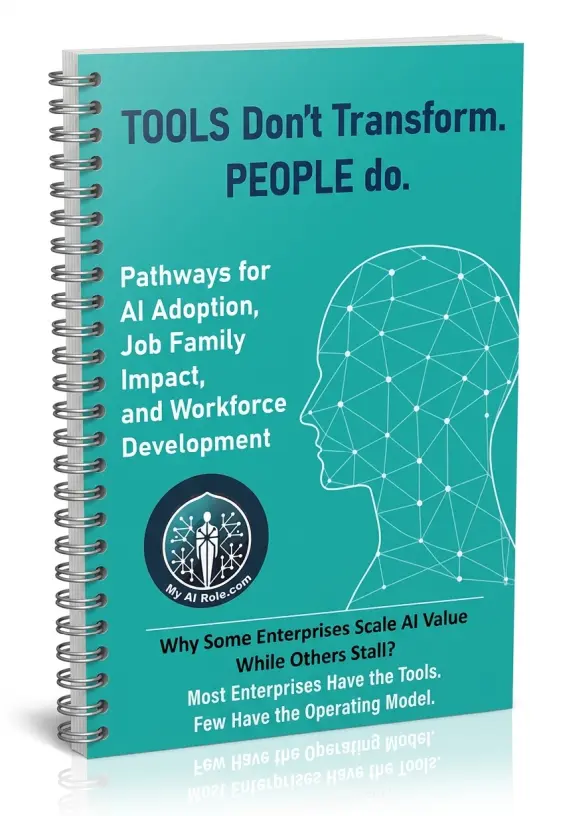
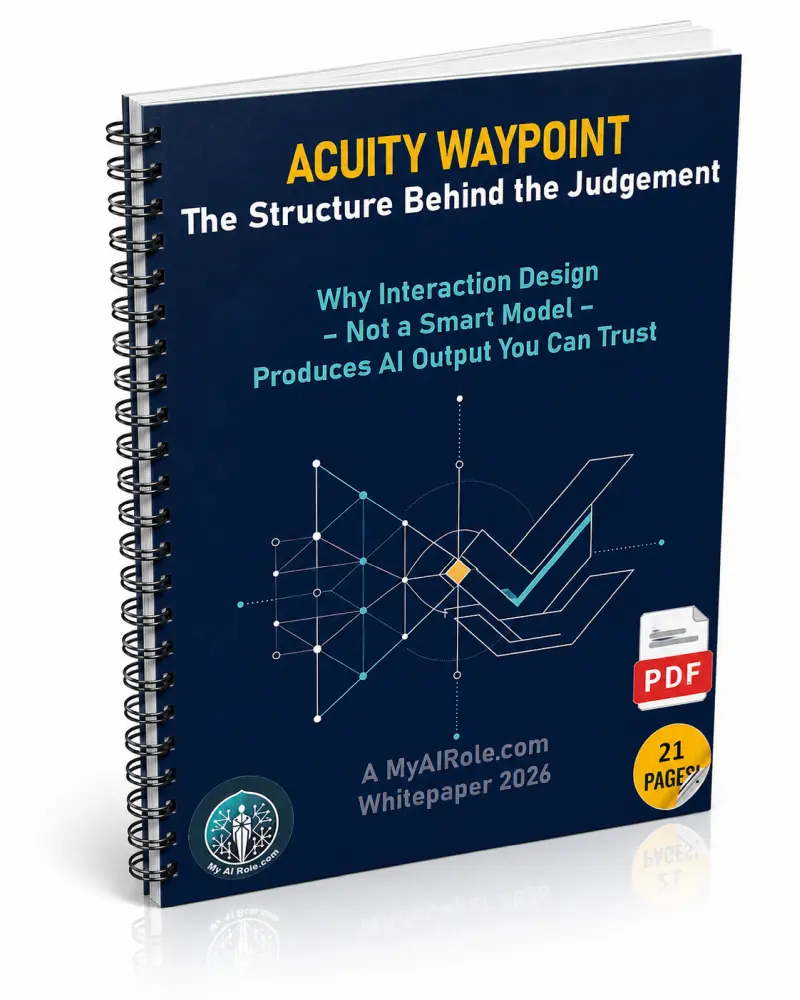
Tools don't transform. People do. An executive guide built on that premise — and one specific finding: AI programs stall because no one redesigned the work around the tools. The guide shows how the MyAIRole Work Structure Framework maps which job families are affected first, what decisions that requires, and how to sequence workforce moves before AI investment compounds the wrong structure — and what the enterprise's most irreplaceable roles need to look like after the restructuring is complete.
Written for CEOs, COOs, and Transformation Leaders accountable for that outcome — and for the leadership teams making workforce decisions as AI restructures how work gets done.
Written by Jorg — creator of the AI Superpower Assessment and the MyAIRole Work Structure Framework — drawing on 25+ years of designing workforce structures for organizations that deployed technology without redesigning the work, and paid the cost.
Step 2: Advance with a Workshop
The whitepaper aligns your leadership team on the question. The workshop answers it: which job families are changing first, which capabilities to build, and how to sequence the next 90 days. One session. Five named outputs. A workforce Rewired for Relevance before the session ends.
Request Workshop Overview →Takes five minutes to review. One page. Everything your leadership team needs.
Step 1: Start with the Whitepaper — The research behind the framework. One submission. We'll send the whitepaper and follow up with the Workshop Overview — one page: the session format, the five outputs, what your leadership team leaves with. Enough to decide if this is the right session for your organization. Submit your details and we'll send it directly to your inbox.